Thursday, January 30, 2014

Anne of Avonlea

"Perhaps she had not succeeded in 'inspiring' any wonderful ambitions in her pupils, but she had taught them, more by her own sweet personality than by all her careful precepts, that it was good and necessary in the years that were before them to live their lives finely and graciously, holding fast to truth and courtesy and kindness, keeping aloof from all that savoured of falsehood and meanness and vulgarity. They were, perhaps, all unconscious of having learned such lessons; but they would remember and practice them long after they had forgotten the capital of Afghanistan and the dates of the Wars of the Roses."

Anne of Avonlea by L.M. Montgomery

In the second book, Anne is no longer the student: she has become the teacher, and she pours her soul into it, as she does with everything.  She is home to help Marilla with their two new additions: twins Davy and Dora.  She also makes several new friends, who keep life interesting and full of love and imagination.

A wonderful read.  I love watching Anne grow up.


Anne of Green Gables

"Kindred spirits are not so scarce as I used to think. It's splendid to find out there are so many of them in the world."

Anne of Green Gables by L.M. Montgomery

Good heavens, how could I have never known Anne of Green Gables?  I have never read this book and I can't imagine how or why!  The only comfort I have in waiting so long is that I have now had such a fun treasure in my twenties that I never knew about!

When Mary saw I was reading this she asked me, "Have you come to kindred spirits yet?"  :)  What a delightful term for those people we all hold near!

I just love this book - it went right along with happy people living in mountains and now on islands!  Anne is so wonderfully endearing I understand exactly why she has become so well known over the years.  Perhaps I love her most because she always has such great intentions.  She is such a fun protagonist.

To start the series, Anne leaves an orphanage to live with a brother and sister (Matthew and Marilla) in Green Gables.  They had planned on a boy, but feel so badly for Anne that the keep her.  Over time, they come to love Anne, in spite of (or maybe because of) her many incidents and accidents.  It is a beautiful, rich story.  I will undoubtedly read this again and again (books 2-7 are on my library counter to read right away!)

LOVED this.

Quiet: The Power of Introverts in a World That Can't Stop Talking

"Don't think of introversion as something that needs to be cured."

 Quiet: The Power of Introverts in a World That Can't Stop Talking by Susan Cain

I heard about this book some months ago and thought, "As introverted as I am, I probably ought to read that."  I have come to generally accept that I'm introverted but feel mostly inconvenienced by it, especially at work, where I need to be a team player and negotiator.  This was a great book.  Perhaps more than anything else it made me feel empowered as an introvert: reassuring me that there are many others that are also introverts that are highly effective and successful.

The book climbs through different themes, including how we came to be a nation that so highly prizes extroversion, what introverts are naturally good at and how introverts can be more effective at extroverted tasks.

There were a number of times throughout the book that I felt like shouting, "That's me!  That is me!"  One example:

"Introverts, in contrast, may have strong social skills and enjoy parties and business meetings, but after a while wish they were home in their pajamas. They prefer to devote their social energies to close friends, colleagues, and family. They listen more than they talk, think before they speak, and often feel as if they express themselves better in writing than in conversation. They tend to dislike conflict. Many have a horror of small talk, but enjoy deep discussions."

I also found a great definition for one of my key characteristics, which Cain describes as "high sensitivity."  This is me to a T:

“The highly sensitive [introverted] tend to be philosophical or spiritual in their orientation, rather than materialistic or hedonistic. They dislike small talk. They often describe themselves as creative or intuitive. They dream vividly, and can often recall their dreams the next day. They love music, nature, art, physical beauty. They feel exceptionally strong emotions--sometimes acute bouts of joy, but also sorrow, melancholy, and fear. Highly sensitive people also process information about their environments--both physical and emotional--unusually deeply. They tend to notice subtleties that others miss--another person's shift in mood, say, or a lightbulb burning a touch too brightly.”

 I just felt so empowered by the whole thing.  As soon as I finished I handed the book to TJ and said, "Read this.  It will teach you all about me."  I think that, in spite of our full book shelves, I may just spring and buy this one.  I definitely think I'll be reading it again.


Tuesday, January 21, 2014

I, Juan de Pareja

"Art must be true.  It is the one thing in life that must rest on solid truth.  Otherwise, it is worthless."

I, Juan de Pareja by Elizabeth Borton de TreviƱo

In my quest to read all the Newberys, I picked up "I, Juan de Pareja" in January 2009.  Because I love Spain, and I know who Velazquez is, I devoured the story, wishing genuinely that there was more.

Velazquez is a renowned Spanish painter from the seventeenth century.  His most famous piece of artwork, "Las Meninas" is an intriguing work that I feel privileged to have seen in person.  I, Juan de Pareja, is a book about Velazquez through the eyes of his slave, Juan de Pareja.  Juan is inherited by Velazquez when he is a young boy and becomes a pillar for Velazquez: he sets the canvases, washes the brushes, arranges the palette, and travels many miles at his master's side.  It is a captivating story, both in regards to the artwork that Velazquez created, and in terms of the beautiful relationship that unfolds between master and pupil.  Juan's voice is simple and raw, filled with honesty and emotion.

Whenever I am asked about my favorite book I respond that it is "I, Juan de Pareja."  I can't believe five years have passed since I read it, but I truly enjoyed again experiencing the surprise that comes from being uncertain how it would all go.  I love this book.

By the way, the cover is snatches of the artwork of Velazquez, which I also just love.  Go look up "Las Meninas" and read a little about the history of it.  It is the only self-portrait we have of Velazquez.

Friday, January 10, 2014

Letters

In a letter to her husband:

Dearest darling,

       I've been away from you enough during the last year to last me for the duration of this existence and I hope Heaven is a small place or travel is by instant atomic force."

Letters by Marjorie Pay Hinckley

As a sophomore in college I spent a semester studying abroad in Spain, about an hour outside of Madrid.  I went with a group of about 30 other kids from my university in the US and we lived with families for the 3 months we were there.  Each morning we had class for several hours and then we had the afternoon to spend how we pleased.  Several of the kids jumped on the train after school each day and headed to the city, where they spent hours, then days, then weeks and months exploring Madrid and beyond.  After class each day, I walked home and stayed there.

My genuine hope while living in Spain was to know what it felt like to live in Spain.  I spent as much time with my family as possible, because I wanted to see and know and feel how they lived.  I spent two hours at lunch with them everyday.  I watched TV and movies with them.  I played games with them, made dessert with them, practiced French with them and went on walks with the dogs.  I was fascinated by the quotidian lifestyle and have no regrets about how I spent my time.

I find I am still drawn to people that live quiet lives of consistency and build a life out of routines, habits and little actions.  I love Marjorie Pay Hinckley because she was genuine, full of life, humorous and involved in the day-to-day.  I just finished reading Letters, a compilation of letters she wrote throughout her life, for the second time and enjoyed it yet again.  It feels to me like sitting down with one of the older women you love, cherish, admire and lean on because their experience in life has granted them wisdom and stability that is gained no other way.  Her letters made me laugh on several occasions and made my heart hurt on others.  She brought countries of the world to life with her descriptions of them and she pushed me to reach out to family members more consistently (if she can drop postcards to grandkids from countries around the world I can certainly take time to reach out to those that are a few miles away).  I just really love this book.  She makes me feel so optimistic about life.

By the way, I typically link the title to amazon but this book is particularly hard to find as it's been out of print for a half dozen years or so.  I just got my hands on a used copy and after cleaning up the cover a bit it's good enough for me: happy hunting!

Bright Island

Sailing was better than flying.  You sat still and the clean water poured around you, and the sweet air washed you clean.

Bright Island by Mabel L. Robinson

I remember that in high school someone asked me what kind of books I liked and I responded, "Happy books about nice people who live in mountains."  Christy, by Catherine Marshall, was one of my favorite reads at the time and I found a few other treasures about people living on the land that I really enjoyed.  I have clearly broadened my horizons to now include happy books about nice people who live on islands.

Bright Island is about Thankful Curtis, a young girl that lives with her family as the sole inhabitants on an island off the coast of Maine.  Thankful thrives on her island and lives for her icy plunges in the water each morning and sailing every afternoon.  She loves watching the stars and living off the land.

But Thankful is sent to the mainland to go to finishing school with other children her age.  She has never been in so much noise or with young people her age, to say nothing of her confusion about modern-day conveniences.  She struggles and learns, makes mistakes and grows.

It was not a profound book, but I really enjoyed it.  It is one I would pick up again to enjoy the sights and smells and sounds of Thankful's Bright Island.

Sunday, September 1, 2013

Garlic and Sapphires

Every restaurant is a theater, and the truly great ones allow us to indulge in the fantasy that we are rich and powerful. When restaurants hold up their end of the bargain, they give us the illusion of being surrounded by servants intent on ensuring our happiness and offering extraordinary food.  

But even modest restaurants offer the opportunity to become someone else, at least for a little while. Restaurants free us from mundane reality; that is part of their charm. When you walk through the door, you are entering neutral territory where you are free to be whoever you choose for the duration of the meal.

Garlic and Sapphires by Ruth Reichl

What an interesting book.  I now feel like I should be eating infinitely more fancy food, all the time.  (Though I confess that when I eat my very simple chicken tacos at home with my husband I feel like it's all I need, which might explain why we've had chicken tacos at least three nights a week for four weeks straight now.)

Ruth Reichl was hired as the food critic for The New York Times in the 1990s.  She moved her family across the country and settled in New York City where she dove right in.  This was a fascinating life for me to hear about: I had no idea that such people exist, frankly.  I mean, I assume that somewhere in my mind I realized that there were food critics and that they ate out a lot, but I didn't full understand that to give a fair review you probably needed to eat at the same place 3-5 times trying more than a half dozen dishes each time.  I thought I had a hearty appetite but I really respect someone who can sit at the same table eating the same meal for five hours straight.

Also, I don't drink alcohol so the wine aspect of this book was really fascinating to me.  I'm trying to think of a non-alcoholic similarity but I just can't seem to find one: seems like a very rich experience for so many.  It's really interesting for me to read about the sommeliers and the wine snobs and the depth and flavor of a good wine.

Aside from the wine, I really enjoyed simply getting a glimpse into such a different lifestyle from my own.  I have never tasted about 90% of what she wrote about (I had to ask TJ what foie gras was) and I am confident I'm incapable of naming every ingredient in the foods I eat.  Aside from being able to taste things in details (an odd combination in writing) she is a great writer.  Her food descriptions were gorgeous - I can see why she was given the job.  This short description of noodles gives you a taste of her writing:

I was not prepared for the feel of the noodles in my mouth, or the purity of the taste. I had been in Japan for almost a month, but I had never experiences anything like this. The noodles quivered as if they were alive, and leapt into my mouth where they vibrated as if playing inaudible music.

One thing I really appreciated was the clean language...until about halfway through when there were three instances of the f word on one page.  I sure wish that would have been left out!  There were a couple other swear words so if you're a sensitive reader (as I consider myself to be) beware.  You could certainly skip that page without missing a beat, which makes me think I should've grabbed the page number before returning it.  Sorry about that.

If you're looking for a look at a different lifestyle (assuming you're not already a food critic) this is a fun read. 

Tuesdays at the Castle

There were only two rules the Castle seemed to follow.  Rule One: The throne room was always to the east.  Rule Two: If you turned left three times and climbed through the next window, you'd end up in the kitchens.

Tuesdays at the Castle by Jessica Day George

Sometimes when I walk through the shelves at the library I snag books based entirely on their cover (and usually their inside flap).   This book was one of those, from the award book section in juvenile fiction that I frequent every time I'm a
t the library.  It was a fun, fluffy read, one of those that reminds me of why I so loved (and still do) indulging in books as a child. 

The Glower family lives in an enchanted castle that can transform as it pleases.  Each Tuesday something changes: a new wing added, a hallway lengthened, a secret passage where there was nothing before.  It is a fun, intriguing building and the kids love to live there. 

A few pages in, however, the king and queen have gone missing and the three Glower children at the castle must use it to fight those that are trying to take over.  The kids are involved in pranks as well as dangerous adventures as they join forces with their castle to try to make sure the crown stays protected.

Though there was nothing that made it really stand out in a literary sense, for me this book rates high.  It was just fun!  I loved being taken away by my imagination.

Two post scripts here: first, I am the dork that almost always reads about the author and reads through their notes at the end.  I was delighted to see that Jessica Day George not only lives in Salt Lake City but also attended BYU, my alma mater.  Second, my nickname (from one of my siblings) is Glower - odd, but true.  It was hard to read about the Glower children without a smile coming to my face because of it.

The 5 Love Languages

For love, we will climb mountains, cross seas, traverse desert sands, and endure untold hardships.
Without love, mountains become unclimbable, seas uncrossable, deserts unbearable, and hardships our lot in life.


The 5 Loves Languages: The Secret to Love That Lasts by Gary Chapman

When I just looked this book up on Amazon to link the title to purchase it, I saw that it was the #1 seller in marriage books.  That is very impressive.  I'm not really surprised.

I devoured this book in a couple days.  I believe I could have read it in one sitting but made myself take time to digest things as I went.  I have heard many reviews of it and was delighted to finally get to it.  Frankly, I probably should have purchased it to read it sooner, as it was always checked out at the library - it was that good. 

Surely there are many reviews of this you could read.  As soon as I finished it I handed it to TJ, which is maybe the best thing I can say about it.  I told him that I wanted him to read it - truly wanted him to - and that it was due in two days.  To his credit, he put his book (The Princess Bride) on hold and jumped right in.  We've talked about it extensively since and he speaks of it as a very enlightening book. 

Dr. Chapman's hypothesis, which he believes thousands of couples have proven, is that everyone has a native, or primary, love language.  He believes there are many dialects of these languages but there are truly just five love languages.  Research shows that the "in love" feeling so associated with dating and engagement disappears after about two years and at that point love becomes a choice.  Each person receives love in a different way and it becomes very significant for each person to receive love in the way that is most meaningful to them.  Most of us were brought up by parents that spoke one or two languages so we frequently are far from proficient in each language.  Marriage, then, becomes a learning place where we often need to learn the language of our spouse.  For love to thrive and for the marriage to be wonderful we need to consistently choose to speak the language of our partner. 

The languages are:
1. Physical Touch
2. Words of Affirmation
3. Acts of Service
4. Receiving Gifts
5. Quality Time

The book describes each in detail and what you can do to learn that language.  I really loved it.  I believe TJ and I have mostly concluded the primary love language of each and our more consistently working to speak them.  It has been an eye-opening experience for us and one we truly appreciate.

This one is good stuff.  I'm asking for it for Christmas (if I don't gift it to TJ for his birthday).

Monday, June 10, 2013

French Kids Eat Everything

Chances are, my children are not going to grow up to go to Harvard, or to be major league sports stars, concert musicians, or NASA astronauts.  But no matter who they grow up to be, how and what my children eat will be of great importance to their health, happiness, success, and longevity.

French Kids Eat Everything: How Our Family Moved to France, Cured Picky Eating, Banned Snacking, and Discovered 10 Simple Rules for Raising Happy, Healthy Eaters by Karen Le Billon

Last year I picked up the audio version of Bringing Up Bebe and went back and forth between being entirely intrigued by it and being sort of bored with it.  Overall, though, I enjoyed it and picked up some insights along the way.  One of the most captivating themes of Bringing Up Bebe, for me, w
as the way that French families, and children in particular, eat.  So when Janssen said that French Kids Eat Everything was one of the best books she's read this year, I went and snagged it from the library.

This is such an interesting book.  I really enjoyed it.  The foundation of the book is that the narrator, Karen Le Billon, married a man (Philippe) from France.  When their children were 2 and 4 they decided to move from Vancouver, Canada back to France for a year.  Both she and her husband were given a one year leave from the university where they taught and they moved to the same village as his parents, in Brittany, France.

And so the adventure begins, with all sorts of cultural mishaps, misunderstandings and mistakes.  Children, and adults!, in France eat so differently from those in North America.  Karen is quite floored to see children at the age of two eating a four course lunch in day care everyday with utensils.  There is no whining or crying or complaining.  The kids eat things like fish, leeks, beets, and Roquefort cheese on a daily basis (I showed TJ the menu for one week of preschool lunches and we truly did not recognize 70% of the foods on it).  It is so fascinating. 

Over twelve months Karen, with the help of her husband, his family, friends and other locals, starts figuring out what the French do differently that make their kids like all sorts of things that her kids won't touch (and neither will any other child in North America) and why they are so well behaved at every meal.  Eventually she compiles a list of ten rules, each of which is explained in the book. 


Many/most of these rules is pretty contrary to the norm for North American parents so it was refreshing to see a new perspective.  That said, I don't think the typical person in North America could follow these to a T, which she discusses in the last chapter (after they've had to make adjustments in Vancouver themselves).  However, as TJ and I discuss someday having children, some of these ideas take on greater weight for me.  My biggest takeaways:

1. Food should be used for nutritive purposes only.  This does not mean one should eat only to meet dietary guidelines (in fact, the number one purpose of food in France is pleasure, which I think is delightful), but rather that food should not be a pacifier, a distraction, a soother, or a threat.  The French would simply never think to say, "Stop hitting your sister or you don't get dinner."  They (including kids) would also never wander to the cupboards when bored.  It is just engrained in them that meal times are 7:30, 12:30, 4:30 (for the kids) and 8:00 that they don't do differently.  Already I sneak candy to the kids all around me and realize now I am encouraging food as a comfort or distraction, which only breeds problems in the long run.

2. Kids can like all foods.  Research shows that it takes 12-15 instances of exposure to like a food (taste is learned).  The French master this by beginning to introduce everything they can think of (really) before the child is 2 years old (at which point a fear of new things sets in: irrelevant when everything is already familiar).  This concept is practiced both at home and at school, as vegetables, especially, are served as purees, sauteed, raw, in salads, as side dishes, and in casseroles.  Parents are gentle but firm in insisting that the children try them and peer pressure often helps the situation.  In the end, the children do truly learn to leave all different things, which I just don't see where I live.  My goal, which I know is aggressive, will be to introduce many vegetables between the ages of 1-2 (the French typically feed their child a leek puree [I've never had leeks] before anything else, including cereal).  The plan is to start making these with TJ now!

3. Food should be enjoyable, not guilty.  This goes against everything I've been taught growing up: I love it.  I really appreciated that the French believe that food is meant to be enjoyed: it should not be a source of guilt or anxiety.  The quote at the beginning of this post sums it up for me: eating is a part of life and should be healthy, happy and enjoyable.  For too many people that is not the case and I think we can do better training our children!

And on that note, go read the book.  It's fascinating.  And it taught me that maybe if I just give olives a few more tries I'll like them.

Wednesday, June 5, 2013

Emmy and the Incredible Shrinking Rat


Emmy and the Incredible Shrinking Rat by Lynne Jonell

I may as well get to the point: I absolutely loved Emmy and the Incredible Shrinking Rat.  It was such a FUN read.  I remember watching Monsters, Inc. and walking away saying, "That was a fantastic show.  I can't believe they could construe such an absurd story line into something cohesive."  I felt much the same way about Emmy and the Incredible Shrinking Rat: I could never adequately describe the book but it was just so good.  And so, I'll take a stab at describing it.  :)

Since Emmy's parents inherited a massive fortune from a great uncle they never knew, they have been traveling the world, leaving Emmy in the care of a nasty nanny, Miss Barmy.  Miss Barmy is simply not kind but she is also very odd: she makes Emmy drink all sorts of strange things, rub things behind her ears, keep a remarkably full schedule, and be the perfect child.  It's a mess.  But one day Emmy stumbles on Miss Barmy in an area of town she's never seen before: a rodent store that houses all sorts of animals with unique tags on them, listing powers and abilities of each. 

And on the story goes: a well-woven plot about some impressive rodents and a smart little girl who figures out Miss Barmy while dealing with her own innocent emotions.  It was such a fun ride: one I will certainly purchase for my children and read with them again and again.

Tuesday, June 4, 2013

Seedfolks

"Gardening boring?  Never!  It has suspense, tragedy, startling developments-a soap opera growing out of the ground.  I'd forgotten that tremolo of expectation produced by a tiny forest of sprouts.  A fact bobbed up from my memory, that the ancient Egyptians prescribed walking through a garden as a cure for the mad.  It was a mind-altering drug we took daily."

Seedfolks by Paul Fleischman

TJ and I went out to eat with some long time friends at Cafe Madrid, our favorite (...only) local Spanish restaurant.  The food was delightful and the company was great: we sat at the table for three hours.  For a good 45 minutes we discussed books, which is something I can certainly get excited about.  As usual, I suggested Funny in Farsi, which is probably in my top 3 favorites of all time.  Our friends suggested Seedfolks, which they said was a "good, quick read."  They were right.  I picked it up from the library three days later and read it in an hour.

There is an empty lot in the middle of Cleveland that has turn into a dumping ground of sorts: it's filled with old tires, refrigerators, a sofa and rats.  But a little girl who misses her father starts an unexpected change in the old lot when she plants a few beans: she hopes her dad will look down from heaven and see that she is just like him, gardening.  Each chapter introduces a different character, who goes to the lot for a different reason, planting hope with their various seeds.

I anticipated that the same 3-5 characters would each have a few chapters of narration but every chapter, from start to finish, was a different character, thirteen in all.  I really enjoyed it.  My favorite books are happy books and I loved seeing this group of strangers work together to make something beautiful.

I'm uncertain the best age for reading this but you could certainly have some good conversations with children about acceptance, service, kindness and hard work.  I heartily recommend this one.

Friday, May 24, 2013

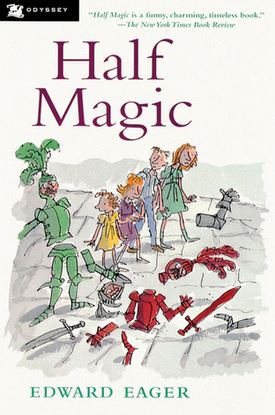
Half Magic

"Still, even without the country or a lake, the summer was a fine thing, particularly when you were at the beginning of it, looking ahead into it. There would be months of beautifully long, empty days, and each other to play with, and the books from the library.”

Half Magic by Edward Eager

As with most of the book recommendations I pursue, I picked this up based on a recommendation by Janssen at Everyday Reading.  She lists it as one of her favorite middle grade books and I agree completely.  In fact, I told TJ that this is the exact kind of book I imagine reading to our kids on road trips in the future.  It was innocent, fun, entertaining and plain old wholesome: my favorite combination for a book.

Four siblings - Jane, Katharine, Mark and Martha - find a charm one day and, after a sequence of odd events, figure out that the charm grants them exactly one half of everything they wish.  With that understanding in place the four of them set out to have several wonderful adventures together, fumbling through some wacky wishes (caused by unsound math).  It was a lot of fun to see what sorts of adventures were the most exciting to them (they take turns with the charm) and it was quite funny to see what went awry. 

I also really enjoyed the narrator's voice, which I felt was the perfect tone for children.  I imagined the narrator as a he, since the author is a he, and he acknowledged the audience by saying things like "you know exactly what I mean" or "as I'm sure you know."  They were the sort of acknowledgements that I would bet make children feel connected to the book even further.  A great touch, I think.

I did close this book with a homework assignment to read something by E. Nesbit.  I'm ashamed to say I don't even know who it is but Edward Eager, the author, mentions Nesbit in every book he writes in an effort to point children to her books.  I'll add her to my list!

Tuesday, January 22, 2013

Every Soul a Star

"Wherever you end up, I wish you clear skies.  Always."
-Every Soul a Star, Wendy Mass

Every Soul a Star by Wendy Mass

At the same time I was reading Major Pettigrew's Last Stand, I was listening to the audiobook for Every Soul a Star.  The two together provided a very nice contrast: while Major Pettigrew was very deliberate and mature, Every Soul a Star had young voices with a quick storyline.

Every Soul a Star has three teenage protagonists and the chapters rotate between each of them: Ally is a down-to-earth girl that lives at a campground with her parents and little brother - she is intelligent, thoughtful and sincere; Jack is an insecure kid living with him mom and brother, but he spends a lot of time in his tree house, where he escapes reality by drawing and daydreaming; Bree is the stuck-up girl from other girls' nightmares - she is obsessed with fashion, her figure, and her prospective modeling career.  I enjoyed that in the audio version each of the protagonists was played by a different person, so their voices were differentiated even further than their voices in the book may have allowed.

As the book opens, Ally, Jack and Bree are all living separate lives.  Ally lives happily with her family, her best friends, at the Moon Shadow Campground.  She and her brother, Kenny, are home schooled and love spending time outside, exploring nature.  Most especially, Ally has been blessed with a great love for the skies and spends many hours exploring the stars.  Her family is preparing for the solar eclipse and their preparations have lasted as long as she can remember: she has never been more excited for any single event.

Jack's life is a constant battle between what he wants to do - art - and what he should do - school.  He has failed science and is trying not to think about looming summer school when his science teacher, Mr. Silver, calls and invites him on a trip to see a solar eclipse.  The two week trip would take the place of summer school, so after approximately 2.8 seconds of thought, Jack accepts.  For the first time he can remember, he fits in with a group, as the others on the bus tour think he's wonderful, in spite of being overweight and imaginative.

Bree has just landed quite an impressive job at the mall's make-up store as Junior Consultant.  She is hoping to start a new modeling career and is the proud leader of the "A Clique" at school.  She gathers pictures of models in her spare time and rates herself, and everyone she sees, on a scale from 1-10 every day.  Her world comes crashing down when her parents announce they're moving and she, against her will, is forced to move with them.

The three meet at the Moon Shadow and have two weeks together leading up to the big eclipse that brought them all there.  They struggle to understand how each of the others thinks and they learn to better understand people in general. 

My favorite thing about this book was how much I learned about the stars and eclipses.  After it ended I told my husband I'd really like to go see an eclipse.  I also learned about exoplanets (aided by my husband's documentary-like explanation of how they're found) and meteorites.  Space is such a fun area to learn about and I liked seeing others' enthusiasm for it.

Maybe what I least enjoyed was the teenage voices: I hated being a teenager, which likely carries into this.  :)  It was okay, and a welcome change of scenery from Major Pettigrew, but I don't think I'll ever pick it up again.

Monday, January 21, 2013

Major Pettigrew's Last Stand

“...I tell myself it does not matter what one reads--favorite authors, particular themes--as long as we read something. It is not even important to own the books.”
― Helen Simonson, Major Pettigrew's Last Stand 

Major Pettigrew's Last Stand by Helen Simonson

Major Pettigrew lives in the countryside of England as a widower in his late 60s.  He is overcome with grief again when he hears of his brother's death, an unexpected occurrence that happens just before the book begins.  He is pulled out of his despair by Mrs. Ali, a shop owner from the village, who stops in and steps in to help when she understands the situation. 

In time, Mrs. Ali and Major Pettigrew develop a friendship, based on loyalty, compassion, genuine concern for the other and time-honored traditions like drinking tea and discussing literature.  (I can't help but think such traditions would be great to start around these parts!)  Of course, even while they are becoming friends they are both dealing with issues that real life deals out: the Major has a moronic son who is selfish and unkind and Mrs. Ali has a nephew she feels obligated to help (he brings a host of issues himself).  The story, then, weaves back and forth between the current events with family and friends and a blossoming love story. 

Until the last 75-100 pages the book was very steady, quite inconsequentially eventful, and, as I can best describe it, deliberate.  The writing is beautiful, detailed and witty, as only an example can demonstrate:

My dear Mrs. Ali, I would hardly refer to you as old," he said. "You are in what I would call the very prime flowering of mature womanhood." It was a little grandiose but he hoped to surprise a blush. Instead she laughed out loud at him. "I have never heard anyone try to trowel such a thick layer of flattery on the wrinkles and fat deposits of advanced middle age, Major," she said. "I am fifty-eight years old and I think I have slipped beyond flowering. I can only hope now to dry out into one of those everlasting bouquets.

I truly enjoyed how rich the text was; it seemed to me that each sentence was crafted to perfection (I can't imagine how someone can write like that and think it is nothing short of a true gift).  It was delightful to be allowed to listen to the conversations of such eloquent characters.

Sadly, I found myself quite disappointed in the ending, which felt very far-fetched considering the previous 300 pages of the book.  Though the ending wasn't sad, the twist was so unexpected and evil that I had a hard time accepting it as the true ending for the book: it left a sour taste in my mouth.  The rest of the pages, however, were a lot of fun to read, and for those that aren't sensitive readers (as I definitely confess I am), this may be the perfect book.

Wednesday, January 16, 2013

A Few of My Favorites

I've been thinking about rereading some of my all-time favorites for the sake of putting their reviews on here.  For today, I'll settle for posting a list (that I'll link over time to my reviews!)

Mrs. Frisby and the Rats of NIMH
Cheaper by the Dozen
A Long Way from Chicago
A Year Down Yonder
The Penderwicks
I, Juan de Pareja
From the Mixed-up Files of Mrs. Basil E. Frankweiler
The Evolution of Calpurnia Tate
Where the Mountain Meets the Moon

Tuesday, January 15, 2013

The Shakespeare Stealer


The Shakespeare Stealer by Gary Blackwood

Over Thanksgiving last year, my husband and I went on an 8 day trip to California.  The first three days we spent at Disneyland, running between rides and eating ice cream with the excitement of children.  On day four we drove down to San Diego, where we met up with his family for the rest of the week.  We ate like it was going out of style, attended his little brother's soccer tournament and played games  And I read.  I walked miles each day with my nose in a book and the sun on my skin: I believe that is my definition of contentment.  Or maybe happiness itself.  Whatever it was, I loved it so much that I read the three books I had taken and, with three days left of the trip, we had to go to Barnes and Noble to find something new.  How devastating.  :)  It was there that I picked up Shakespeare Stealer (and two others...reviews to come).  It was also there that I read it (in California, I mean, not in the bookstore).

The Shakespeare Stealer is a clever story about Widge, a boy whose harsh master makes him learn an ingenious shorthand that he (the master) invented.  Though the system is not nearly as great as the master thinks, Widge masters it and becomes the only person who can capably use it.  One day a disfigured man comes and offers the master a handsome sum to buy Widge and take him away at once: suddenly, Widge's whole future has changed. 

Widge is taken to a whole new world, it seems, as he enters London with the very clear directive of transcribing, in its entirety, Hamlet.  Though the new master won't discuss it, it becomes apparent that his hope is to steal the play and make another traveling group of actors rich with it.  But Widge gets caught up in the magic and the beauty of the play, and soon he becomes involved with the actors and escapes his master to learn the art of acting.  He actually has friends, is learning a skill and, for the first time, has a place to call home as he spends each day rehearsing for the upcoming plays.

Of course there is a twist at the end, but that I won't tell you about; why else would you read it? 

My biggest complaint about this book is that I was so worried about Widge!  I found myself reading as quickly as possible, as though turning the pages faster would protect Widge from his new master, who is enraged when he does not have the play after the first performance.  I wouldn't mind rereading for the sake of taking in more of the details (as opposed to having my eyes flit quickly across pages looking for any signs of distress).  Alas, these concerns are petty issues of the reader, not of the book.  :)  It was a fun read; I think boys around sixth grade would enjoy it very much.

(Oh, and what an interesting time to read about!  In spite of it being fictionalized I really enjoyed thinking about living during Shakespeare's time.)

Monday, January 14, 2013

The Council of Dads by Bruce Feiler

"Slow down.  I've forgotten how beautiful the world really is.  Do you see it?  Do you see it?"
-Bruce Feiler, The Council of Dads, page 170

The Council of Dads by Bruce Feiler

This is one of the best books I've read in some time.  I snagged this from the Reader's Choice area at the library and I am so glad I did!  I devoured it in a day (I can typically measure how good a book is by how long it takes to read) and could start again right now!  The number of Amazon reviews (44) tells me that not nearly enough people have heard about this book, so let me do my part: this is a great read.  A thoughtful read by a remarkable author (if all sentences were written as well as his, reading would always be more pleasant than eating, I think).

Bruce Feiler and his wife, Linda, have twin two-year-old daughters (Eden and Tybee - such beautiful names) when Bruce is diagnosed with cancer.  Bruce has osteosarcoma, a disease than fewer than 100 adults in the US get a year.  This book covers the time frame of what he terms "The Lost Year": his year of treatments and surgery and war with cancer.  He includes letters he writes to friends and family every 6-8 weeks, which are gorgeously if not painstakingly written and thought-provoking and he includes a narrative about the project that earned the book its name: The Council of Dads.

A few days after his diagnosis, and because he has been worrying about his daughters and the possibility that he may not be around to teach them, Bruce comes up with the idea of forming a group of men that could be his "voice" for his daughters if cancer did take his life.  He and his wife brainstorm together to form a list of six men that each know and represent a distinct part of him and then he meets with each of them personally and reads them a letter he's written, asking them "Will you be my voice?"

As you can imagine, each person he asks is deeply touched and emotional about the situation.  Some of them have been friends for more than 20 years, others for a much shorter time but very deeply.  Between the letters that he writes to family and friends, Bruce writes in depth about his encounters with each of these men he loves and respects and the specific lesson that he would like them to teach his girls if he can't.  In the end, he has six lessons that he summarizes as:

Approach the cow
Pack your flip-flops
Don't see the wall
Tend your tadpoles
Live the questions
Harvest miracles

The last chapter is the letter for his daughters, that brought me to tears when he ended with:

"Take trips, girls.  Take chances.  Take off."

The book didn't feel contrived or superficial to me, at all.  Perhaps it is because people near me are struggling with cancer right now, but I felt like his battle was real, his feelings genuine and his words sincere.  I felt privileged to be included in his life for a few hundred pages, and grateful for the lessons I gathered while reading.

"I believe the best teacher is beauty.  I'll teach them to memorize Auden poems and Shakespeare sonnets so that wherever they are at any given moment in the world, they can just sit under a tree and have Auden or Shakespeare of whomever as their companion for an afternoon..  I'll give them the sound of Mahler symphonies that they can hear again and again and that will always trigger similar emotions.  I'll show them how to appreciate Chinese calligraphy, which is an expression of your internal energy.

"What I want them to know, is how easy it is to see beauty.  How the wonder they felt on that plane never has to leave them.  Miracles are all around them.  They just have to learn to see through the clouds, and go out and harvest those miracles themselves."
-page 195

Oh, and because I respect you, this one had a couple (5 or less) instances of the "f" word.

Friday, January 11, 2013

Replay

"When I am happy, I tap-dance."
-Replay, Sharon Creech

Replay by Sharon Creech

Last time I was at the library I went to grab Love That Dog and Hate That Cat by Sharon Creech...and just grabbed a stack of books while there.  Replay was one of them, and the first one I picked up.  

Replay has several circumstances at play throughout it, but the theme remains: that of players on a stage, whether the stage is life itself, a play at school, the daydreams of a young boy or the stories of the past.  The story is told by Leo, a young boy in an Italian family, trying to figure out what part he plays in life, both the present and in the bigger scheme of things.  He uncovers more as he learns about the past, dreams about the future and prepares for his school play.

I didn't love it.  It took me too long to figure out who was narrating (the voice is that of a child, and it is Leo, but is always in third person) and I think I may have missed the symbolism entirely (which is just a reminder of my lack of training in literary analysis...)  I don't think I'll pick this one up again; too many other options that appeal to me more than this.


Wednesday, January 9, 2013

The Best Bad Luck I Ever Had


The Best Bad Luck I Ever Had by Kristin Levine

I love people with good hearts, both in literature and in real life.  The protagonist of this book has a good heart, which is put to the test when the new family in town, with a girl just his age, is black.  The setting is the early 1900s and Dit (the main character) hoped for a new boy his age to play baseball with: proper Emma, with her avid love for books and distaste for dirt, is the last person he  could imagine spending time with.  But he does, and soon enough he starts liking it.  As a child, he struggles to understand why everyone can't be treated equally: today we do too.  I found myself cheering for Dit as he stuck up for Emma, more strongly over time, throughout the town.  The ending was bittersweet, but it was the right ending which I always appreciate.

I thought this book was especially neat when I realized the title is more than 3 words long and still all the words are capitalized - you don't see that everyday.  :)

A very good read, especially for teaching kids good lessons about the value of each person (or for reminding yourself of them and of the battles the nation has been through to get here).